




Building Operational Capacities for the Use of AI in Counter-Terrorism
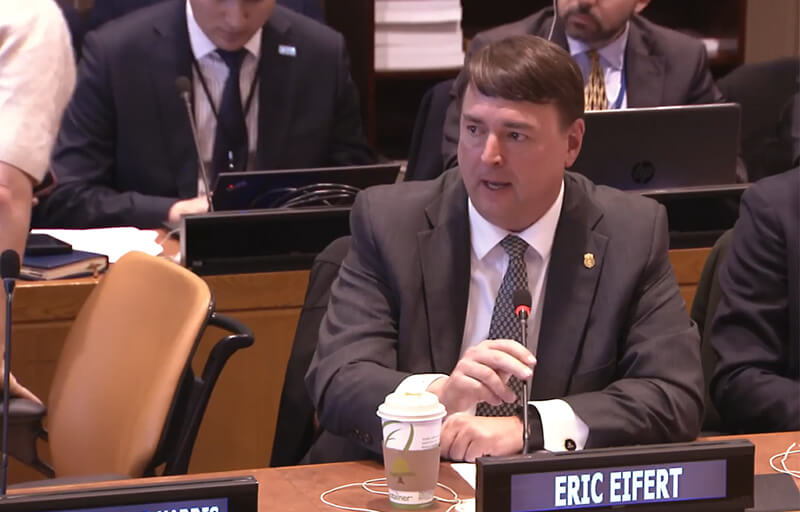
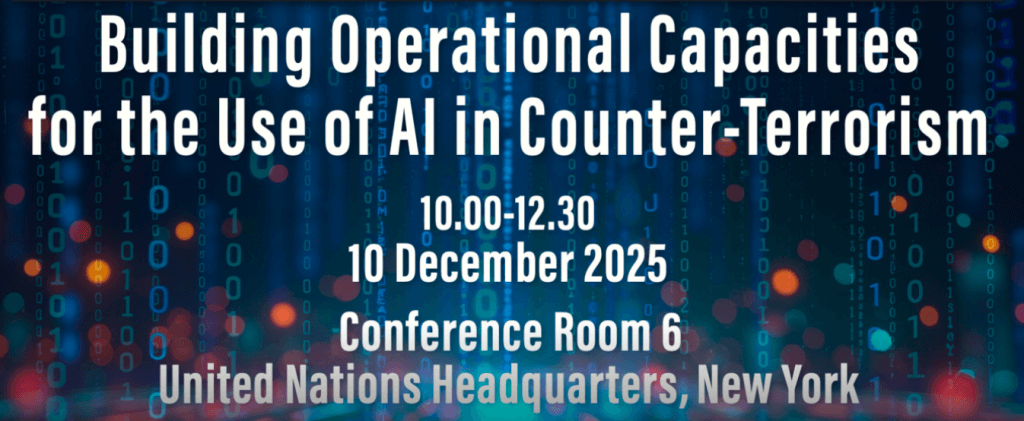
On 10 December 2025, Eric Eifert, leading cyber security expert at the Center for Digital Safety & Security of the AIT Austrian Institute of Technology spoke at the United Nations Headquarters in New York at the high-level conference “Building Operational Capacities for the Use of AI in Counter-Terrorism.” The event, organized by UNICRI’s Centre for AI and Robotics and the United Nations Counter-Terrorism Centre (UNOCT/UNCCT), brought together global policymakers, security practitioners, researchers, and international organizations to examine how artificial intelligence is reshaping the counter-terrorism landscape. The conference opened with remarks by H.E. Ambassador Mohamed Issa Abushahab (UAE), H.E. Ambassador Harish Parvathaneni (India), Alexandre Zouev (UNOCT), and Christophe Monier (UNICRI), underscoring the urgency of strengthening responsible, human-rights-compliant AI capabilities in counter-terrorism.
Background
Artificial intelligence is increasingly central to both operational security environments and the threat architectures of terrorist actors. Law enforcement agencies worldwide rely on AI to detect, investigate, and disrupt terrorist networks, strengthen threat assessments, and protect critical infrastructure from cyber-enabled attacks. At the same time, terrorist groups exploit generative technologies to amplify propaganda, recruit followers, and disseminate sophisticated synthetic media. This dual-use reality underscores the urgent need for capacity building, responsible innovation, and human-rights-compliant governance frameworks — a message echoed across recent UN resolutions, including A/78/265 and A/78/311, and guided by the Delhi Declaration and the Abu Dhabi Principles.
The conference aimed to:
- deepen understanding of how AI acts as both an operational enabler for security services and a tool exploited by terrorist actors
- showcase real-world AI applications for counter-terrorism, including investigative tools, risk assessment systems, synthetic-media detection, and cyber-forensics
- highlight ongoing UN capacity-building initiatives and partnerships with academic and research institutions
- discuss how Member States can navigate evolving threats and harness safe, secure, and trustworthy AI for counter-terrorism in line with international norms and human rights standards
Within the session “The Strategic Landscape and Operational Capabilities”, moderated by Balques Al Radwan (UNOCT/UNCCT), Eric Eifert delivered a dedicated input titled “Capabilities Demo: Deepfake and Synthetic Media Detection.” His contribution presented AIT’s latest technologies for detecting deepfakes and verifying digital content, along with international training programmes designed to raise awareness and build operational capacity among law enforcement and security practitioners as well as critical infrastructure providers worldwide. These tools reflect AIT’s commitment to advancing trustworthy AI enabled solutions that improve global security while upholding transparency, accountability, and human-centred design principles.
A recording of the conference can be found here.
The concept note of the conference can be found here.
Contact
Michael W. Mürling
Marketing and Communications
AIT Austrian Institute of Technology
Center for Digital Safety & Security
T +43 (0)664 235 17 47
michael.muerling@ait.ac.at
www.ait.ac.at